
01 · The problem
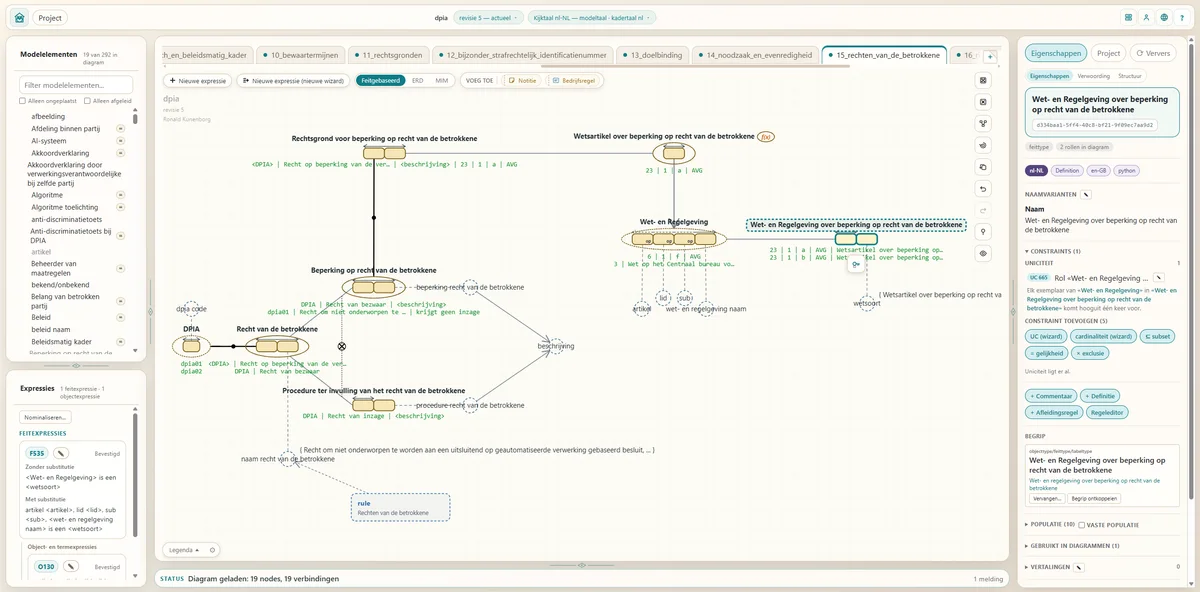
Knowledge lives in heads, not in models.
To most people a data model is a drawing with boxes. The domain expert does not recognise their work in it, the developer fills the gaps alone, and an AI assistant guesses. Knowledge gets lost at exactly the moment you want to share it.
Bolzano starts with a sentence
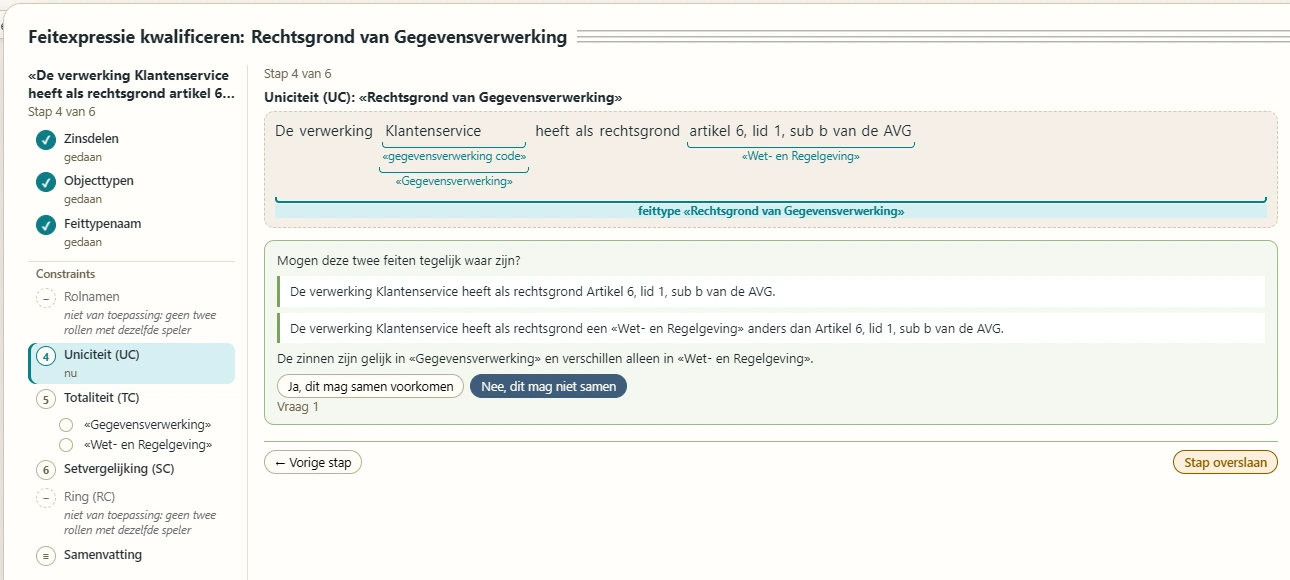
«Processing Customer Service has as its legal basis article 6(1)(b) of the GDPR.»
Blue is what the model recognises as a concept and as a value; the fixed text in between becomes the sentence pattern of the fact type. The sentence stays in charge; the model is its precise translation.
02 · How it works
From example to model, in three steps.
The method is FCO-IM, the Dutch approach to fact-oriented modelling, in the tradition of ORM and the FBM standard. The model comes from the examples, not the other way round.
Step 1
Verbalise
You collect concrete example sentences from the work, in the words of the people who do it. No abstractions, no modeller's jargon.
Step 2
Qualify
You point out in the sentence what is a concept and what is a value. Bolzano recognises recurring sentence patterns and builds fact types, concepts and their relationships from them.
Step 3
Verify
Bolzano asks questions with real examples: can these two facts be true at the same time? The answer becomes a rule, with the example attached as evidence.
03 · Passing on knowledge
One model, two readers.
An AI may propose sentences; Bolzano checks them against the rules, and a person decides what is true.
For your colleague
A model you can read.
A Bolzano fact model is first of all text. Every fact type has a sentence, every rule an example, every concept a definition. That makes it readable for a colleague who has never seen a diagram.
And the model reads itself back as sentences, so the expert can say: yes, that is how it is.
AI-context — dpia
Feittypen
«Gegevensverwerking heeft rechtsgrond»
Sjabloon 1
De verwerking Gegevensverwerking heeft als rechtsgrond Wet- en Regelgeving
Voorbeelden bij sjabloon 1
- De verwerking Klantenservice heeft als rechtsgrond Artikel 6, lid 1, sub b van de AVG.
Regels
- Elk exemplaar van Gegevensverwerking in Gegevensverwerking heeft rechtsgrond komt hooguit één keer voor.
For your AI agent
Context with limits.
A language model does not read an ER diagram, but it does read sentences, definitions and examples. Bolzano exports the whole model as one coherent narrative, which you hand over as context.
Excerpt from the AI context export of a Dutch model
04 · Who it is for
For anyone who has to pass on knowledge without losing any of it.
Information analysts and data modellers
Who want a model the business can judge, with rules that carry an example instead of a checkbox.
Architects in government
Who publish concepts and models according to NL-SBB and MIM, with a traceable line from sentence to standard.
Teams working with AI
Who notice that an agent only performs well once it knows the organisation's concepts, with their rules and examples.
05 · Standards and exchange
Nothing is locked in.
SKOS · NL-SBB
Concepts
Import an existing concept scheme or publish your own, with status and provenance.
MIM 1.2 · SHACL
Models
The Metamodel for Information Models from Geonovum, with SHACL rules to validate data.
FBM
Exchange with CaseTalk
Import existing projects and export without loss.
.blz
Own export
One file with the whole project, including diagrams and revisions, for archiving or handover.
06 · Working together, safely
In the browser, with your organisation.
Bolzano runs in the browser; there is nothing to install. You work within your own organisation, with roles and permissions, and invite colleagues by e-mail. Signing in uses the identity you already have: Google, Microsoft or a one-time code by e-mail.
Every change is a revision; nothing is lost silently.
07 · The name
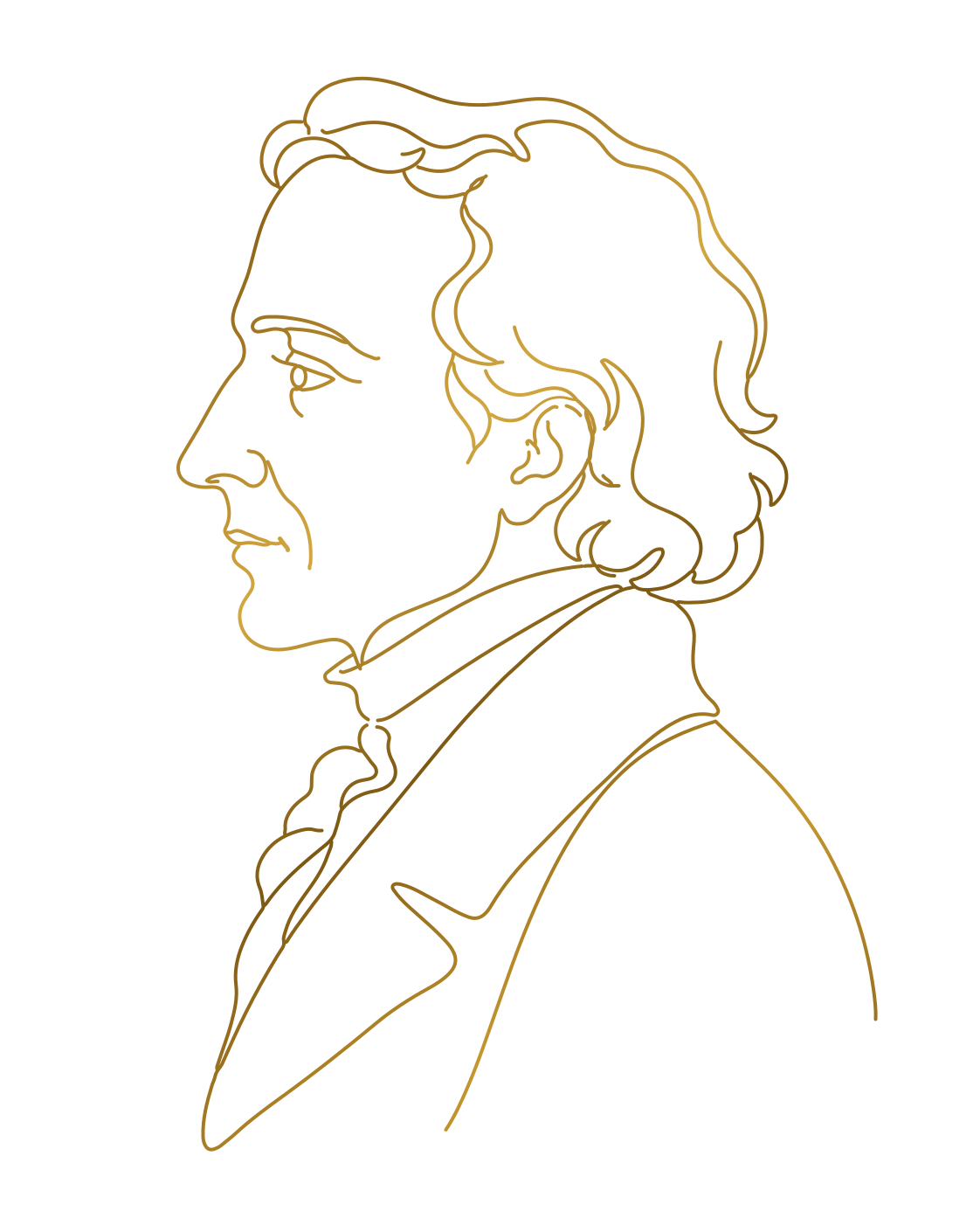
Bernard Bolzano
1781–1848 · Prague
Philosopher, mathematician and priest in Prague. In his Wissenschaftslehre (1837) he described the Satz an sich, the proposition in itself: a sentence that is true or false regardless of who thinks or utters it.
That is where a fact model begins too: with sentences that are true, whoever writes them down.
Bolzano Fact Modeller records those sentences, tests them with examples and keeps them readable, for people and for machines.
Get started.
Bolzano is available to organisations by invitation. Want to try it with your team, or see a demonstration first? Send a message to info@bolzanofactmodeller.nl.